
A memorable wedding send-off is less about choosing the most dramatic prop and more about creating a clear, well-timed experience that every guest can enjoy. Use the steps below to plan an exit that feels personal, photographs well, and ends the celebration with energy rather than confusion.
Choose the feeling before you choose the props
Start by deciding what you want the final moment to feel like: joyful and high-energy, romantic and cinematic, playful, or relaxed and intimate. This choice gives you a filter for every later decision, from the music and lighting to whether guests form two lines, gather in a circle, or walk with you toward a final photo location. Write a one-sentence brief such as, “We want a bright, energetic goodbye that gets everyone involved without making guests wait outside.” Then test each idea against it. A send-off can look impressive but still feel awkward if it does not suit your venue, clothing, guest list, or the way you actually want to leave the reception.
Pick the right send-off format for your venue
Look at the route from the reception space to the final exit and note its width, surface, lighting, nearby doors, steps, landscaping, and possible bottlenecks. A narrow path may work better with guests standing in two lines, while a broad outdoor area can support a moving procession or a loose semicircle around the couple. If the venue has several entrances, specify one exact departure point rather than assuming guests will know where to go. Ask the venue coordinator what is permitted before you buy anything. Some locations restrict open flames, confetti, loose objects, amplified sound, or items that could damage floors and grounds. Also confirm how late the space remains available, whether an outdoor exit depends on weather, and whether staff will need to clear or dispose of anything afterward.
Build the timeline around a real transition
Do not treat the send-off as something that simply happens when the reception ends. Give it a defined place in the schedule, ideally after the last important dance, speech, or dessert service, and allow a few minutes for guests to understand what is happening. Your coordinator, DJ, bandleader, photographer, and venue contact should all have the same planned cue. A practical sequence is: announce the final activity, give guests time to collect personal belongings, direct them to the send-off area, distribute any permitted items, position the couple, then begin the music and exit. Avoid starting while food is being served or while many guests are in restrooms or outside smoking; the moment will feel smaller if half the room misses it.
Give guests one simple job
Guests participate more confidently when the instruction is short and visible. Instead of asking them to improvise, tell them exactly where to stand, what to hold, when to raise it, and whether they should remain in place or walk behind the couple. A sign near the gathering point, a message from the DJ, and one or two helpers repeating the instruction can prevent a long explanation. Choose helpers who are comfortable moving through a crowd, such as members of the wedding party or trusted relatives. Their role is not to police the celebration; it is to guide late arrivals, keep a clear route, and make sure guests at the back understand the plan. If children or older relatives are attending, provide an option to watch from the side rather than requiring everyone to join the moving line.
Use lighting that works for both atmosphere and photographs
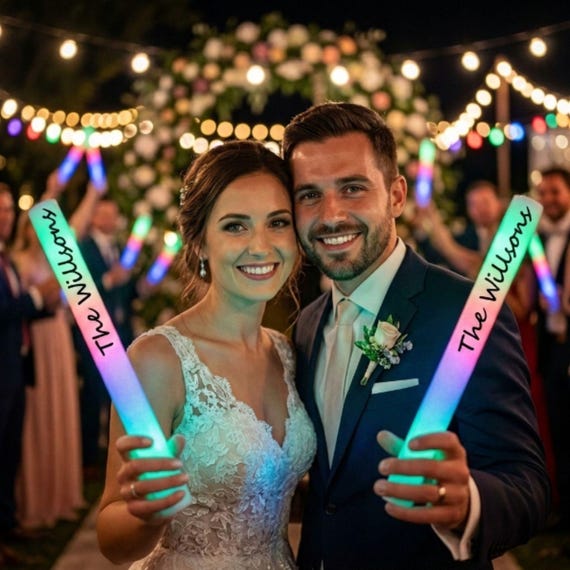
Lighting can make a send-off feel intentional even when the setting is simple, but it needs to be planned from the photographer’s point of view. Ask where the main light source will be, whether guests will be backlit, and whether the couple’s faces will disappear into shadow. Avoid placing bright lights directly behind the couple unless your photographer has chosen that effect and can expose the image accordingly. For a colorful, flame-free option, {{listing:4549858560}} offers custom LED glow sticks and personalized foam sticks in a multicolor party-supply format. If you use them, distribute them shortly before the exit, keep the couple’s route clear, and ask the photographer whether the chosen colors will complement the venue lighting rather than overwhelm the final images.
Use lighting that works for both atmosphere and photographs
Shop the find ↗Design the route for movement, not just a pretty picture
Walk the planned route together before the wedding day. Check whether a dress train, formal shoes, a wheelchair, a child being carried, or a crowded doorway could slow the couple down. Decide where the couple starts, where they pause, and where they finish; even a short route feels more polished when it has a clear beginning and end. Leave enough space for guests to participate without stepping into the couple’s path. Ask the photographer to identify one or two safe positions in advance, then keep those areas free of bags, discarded props, and enthusiastic guests. A planned pause at the halfway point can create a strong portrait, but too many stops may make the exit feel staged or leave guests unsure whether the moment has finished.
Make the music cue unmistakable
Choose a song or instrumental section with a clear opening and enough length for guests to assemble, participate, and see the couple off. Tell the DJ or bandleader the exact cue, not just the song title, especially if the track has a long intro or several possible versions. If you want a change in energy, plan it deliberately rather than relying on someone to fade the music at the right moment. Keep a backup cue ready in case the transition takes longer than expected. The backup might be a short announcement, a second song, or a simple repeat of the chorus. Test the volume at the exit location, because sound that feels balanced in the reception room may be too quiet outdoors or too loud in a confined entrance area.
Plan for guests who do not want to participate
A welcoming send-off should offer more than one way to be involved. Some guests may be carrying a child, wearing delicate clothing, avoiding particular materials, or simply prefer to watch. Give them a comfortable viewing position and make it clear that participation is optional; a crowd looks more natural when people are relaxed rather than pressured. If you are providing handheld items, prepare a place for guests to return or discard them according to the venue’s instructions. Do not leave the cleanup plan until the end of the night. Assign one person to collect reusable items and another to check the route for anything that could become a slipping or tripping hazard once the music stops.
Prepare a weather and timing backup
Outdoor send-offs are especially vulnerable to rain, wind, cold, heat, and changing daylight. Decide in advance whether the backup will move indoors, use a covered walkway, or become a final-room celebration rather than an outdoor exit. Share that decision with the venue and suppliers so nobody has to improvise while guests are already gathering. Your backup should preserve the same emotional purpose even if the appearance changes. For example, the couple might walk through two rows of guests inside, pause beneath a decorated doorway, or finish with a group cheer and final portrait. Make sure the alternate route is accessible, well lit, and wide enough for the photographer to work without blocking the guests.
Give the photographer a shot list without over-directing the moment
Tell the photographer what matters most: the couple leaving together, grandparents or children participating, a wide image showing the full crowd, and a final close-up or doorway portrait. Mention any meaningful people or details that should appear, but avoid demanding a long sequence of posed images when the send-off is meant to feel spontaneous. Share the route, timing, lighting plan, and likely guest positions ahead of time. Ask where the photographer needs to stand and whether assistants or a second photographer are needed for the chosen setup. On the day, appoint one person other than the photographer to manage the crowd so the photographer can concentrate on expressions, focus, exposure, and the couple’s movement.
End with a deliberate final beat
The best send-offs do not simply dissolve when the couple reaches a car or doorway. Choose a final beat: a kiss beneath the lights, a wave from the steps, a last group cheer, a private pause before departure, or a short moment for the couple to look back at their guests. Tell the photographer and coordinator where this ending will happen so they can protect the moment instead of rushing everyone onward. After the final image, make the next step obvious. Someone should know whether guests are returning inside, collecting coats, waiting for transport, or heading to an after-party. A clear ending helps the celebration feel complete and prevents the couple from being surrounded by questions while they are trying to leave. Keep the final instruction warm and concise, then let the couple enjoy the last few seconds without additional choreography.


