
Your cake cutting does not need a complicated performance or a long list of props to feel special. A few intentional choices—such as a meaningful song, a private ritual or a keepsake you can use again—can turn a familiar reception moment into something that reflects your relationship without creating extra work.
Decide what the moment means to you
Before choosing decorations or music, agree on what you want the cake cutting to represent. It might be your first shared task as a married couple, a playful pause in a busy reception or simply a chance to thank the people who helped you get there. Naming that purpose makes later decisions easier because you can assess each idea against the feeling you want to create. Keep the meaning simple enough to explain in one sentence. For example, you might tell your photographer that the cake cutting is about celebrating family recipes, or ask your DJ to frame it as a relaxed transition into dancing. A common mistake is copying every tradition without considering whether it suits you; personalisation often comes from removing elements that feel performative, not adding more.
Choose a short, meaningful song
Select a song connected to your relationship rather than searching for a track that is traditionally associated with cake cutting. It could be the song from an early date, one you listened to during a major move or a piece that makes you both laugh. If the full track is long, ask your DJ or bandleader to use a short section that reaches the mood quickly. Share the cue with your venue team, photographer and whoever is introducing the moment. This prevents the music from starting while you are still finding the cake table. Also check the practical details: whether the song can be played at a comfortable volume, whether it will interrupt speeches and whether you prefer to cut the cake before or after the first dance. The goal is a smooth transition, not a production number.
Add a topper that tells one small story
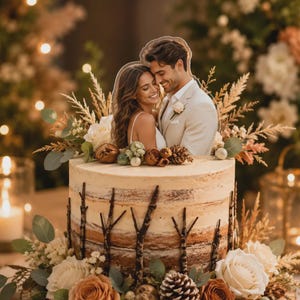
A cake topper can carry a personal detail without requiring a speech or a large display. Consider a shared photograph, a visual reference to where you met or a design that echoes another part of your stationery. Choose one story rather than trying to represent every stage of your relationship; guests can appreciate a clear detail more easily than a crowded collection of symbols. If you are considering a custom photo design, allow time to review the image and confirm how it will be prepared for the cake. The {{listing:4518364703}} is a custom photo cake topper made from acrylic, so it may suit couples who want the cake to include a recognisable image as part of the decoration. Ask your baker where the topper can safely be placed and remove it before serving if necessary.
Add a topper that tells one small story
Shop the find ↗Use a family or cultural tradition on purpose
If cake cutting connects with a family, religious or cultural custom, ask relatives to explain the meaning rather than assuming every guest knows it. A brief note in the programme, a sentence from the emcee or a quiet explanation at the table can make the ritual feel welcoming without turning it into a lecture. You can also combine traditions thoughtfully, such as using a family serving utensil while following your own preferred way of cutting. Speak with both families before the wedding if the tradition is important or has variations. This is especially useful when customs involve who cuts first, how the cake is shared or whether a piece is saved. Avoid adding a ritual solely to please someone else; a respectful adaptation is usually more comfortable than performing a version that does not feel authentic to either of you.
Make the serving set part of your future story
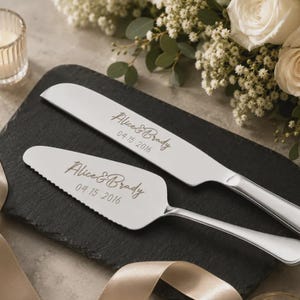
A cake knife and server can become a practical reminder of the day if you choose them with future use in mind. Think about whether you would like to bring them out for anniversaries, birthdays or another family celebration, and decide what kind of engraving would still feel relevant years from now. Names and a date are straightforward; a short phrase or shared initials can be more private and flexible. Review every letter, space and date before approving personalisation, particularly if someone else is placing the order. The {{listing:4518415784}} is a personalised stainless steel wedding cake cutting set with engraving, making it a possible fit for couples who want the cutting tools to serve as a keepsake as well as part of the reception. Confirm delivery timing and coordinate with the caterer so the set arrives at the cake table rather than remaining packed away.
Make the serving set part of your future story
Shop the find ↗Write one sentence for the emcee
A short introduction can give the cake cutting shape without forcing either of you to speak while holding a knife and server. Prepare one sentence that explains why the moment matters, such as, “We are cutting this cake with the same recipe our families have shared for years,” or, “This is our first sweet task as a married couple.” Your emcee can then invite guests to look over without making the moment feel like an announcement at an awards ceremony. Keep the wording natural and tell the emcee how formal you want the tone to be. Ask them not to extend the introduction with unscripted jokes about feeding cake to each other or smashing it into someone’s face. Clear expectations protect your comfort and help the photographer capture genuine reactions instead of a moment that has become awkward or longer than planned.
Choose your cake-cutting boundaries in advance
Discuss the physical part of the ritual before the reception: whether you will feed each other a bite, simply cut a slice together or skip that part altogether. There is no requirement to smear cake on anyone’s face, and agreeing on a boundary beforehand prevents a playful tradition from becoming an uncomfortable surprise. Tell your wedding party and photographer if there are particular actions you do or do not want encouraged. It also helps to decide who takes the first slice and where it goes. You may want to offer it to a parent, save it for later or let the catering team serve it to guests. Mention these preferences during the final catering meeting. Practical instructions are especially valuable when the cake has multiple tiers, delicate decorations or a separate dessert service that needs to be coordinated around the cutting.
Use a personalised set only if it solves a real need
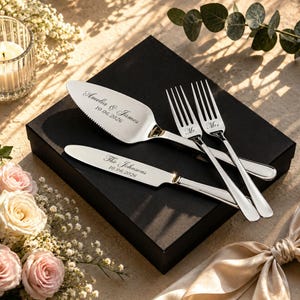
Personalisation works best when it supports the way you plan to celebrate, rather than becoming another item to organise. If you want matching utensils, an engraved cake server set can give the ritual a defined visual detail and provide something you may use after the wedding. If the tools are mainly decorative, make sure the caterer has a separate food-safe serving plan and knows which pieces are for display. The {{listing:4549875107}} is a personalised wedding cake cutting set that includes an engraved cake server, knife and forks, so it may suit couples who want a coordinated set rather than separate utensils. Check the personalisation carefully and confirm how the set will be delivered, stored and cleaned. A simple labelled box or pouch can prevent the pieces from being misplaced during venue setup or the end-of-night packing rush.
Use a personalised set only if it solves a real need
Shop the find ↗Let your photographer know what is meaningful
Photographers cannot know which detail matters most unless you tell them. Add the cake cutting to your shot list and mention any meaningful element, such as a family utensil, a topper photograph or a relative who helped bake the cake. Ask for a mix of wide images showing the reception atmosphere and close images of the hands, decoration and first slice, while accepting that the most valuable photograph may be an unplanned reaction. Plan the location with the photographer and venue team. A cake table tucked against a dark wall or placed behind a speaker can make the moment harder to see, while moving it into a busy walkway creates its own problems. Choose a spot with enough room for the couple, photographer and caterer, and check whether overhead lighting or window glare will affect the cake’s appearance.
Turn a photo topper into a conversation detail
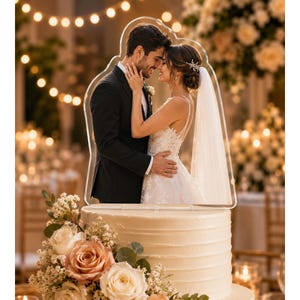
A photograph on the cake can invite guests to notice a lesser-known part of your story, but it works best when the image is clear and purposeful. You might choose a picture from your first trip together, a meaningful shared hobby or an early moment that contrasts humorously with your wedding-day outfits. Avoid using an image simply because it is technically attractive; select one that gives close friends and family something to recognise or ask about. The {{listing:4515185925}} is a custom photo acrylic wedding cake topper, which could work for couples who want the cake decoration to feature a personal image. Send a high-quality file, check the crop and consider how the topper will look from the guests’ seats, not only in a close-up photograph. Ask the baker whether the cake’s height and design leave enough space for the topper without hiding other details.
Turn a photo topper into a conversation detail
Shop the find ↗Plan the practical exit from the moment
The cake cutting often sits between major reception events, so decide what happens immediately afterwards. The caterer may need a few minutes to portion the cake, the DJ may need a clear cue for the next song and you may want time to greet guests before dancing. Ask your coordinator to create a simple sequence: announcement, cutting, photographs, removal of the utensils and the next activity. Keep an emergency plan small. Pack a stain-removal pen, a few tissues and any instructions for the topper or keepsake set, but do not create a separate kit for every possibility. If the cake is delayed, the knife is missing or the room becomes crowded, your coordinator can move the moment by a few minutes. A personal cake cutting is not defined by perfect timing; it is defined by having enough breathing room to enjoy it.


