The best Nerf birthday gifts do more than add another blaster to the pile: they make play safer, easier to organise and more enjoyable for a whole group. Use this guide to build a balanced mix of equipment, targets, personal touches and activities, while checking ages, compatibility and supervision needs before buying.
A clearly organised dart station
Set up one central place for darts, spare equipment and used ammunition so children are not constantly searching under furniture or running through the play area. Open bins, shallow trays or labelled boxes work better than a single deep container because children can quickly see what is available and return items between rounds. A dart station also gives you a natural place to explain the rules before play starts. Separate unused darts from damaged or dirty ones, and do a quick check for tears, splits or other damage before the party. Keeping a small supply of replacements nearby helps the game continue without turning every lost dart into an argument.
Protective eye wear
Eye protection is one of the most practical gifts for an action-themed party, especially when several children will be firing at once. Choose comfortable protective glasses that fit securely without pinching, and have each guest put them on before entering the play area rather than treating them as an optional costume accessory. Plan for fit and hygiene as well as appearance. If you are buying for a group, use adjustable or generously sized options where possible, and clean shared eyewear according to the manufacturer’s instructions. Remind children that glasses do not make close-range shots or aiming at faces acceptable; safe distance and clear boundaries still matter.
A themed invitation that sets expectations
An action-themed invitation can do useful preparation work before the party begins. Include the start and finish times, location, whether play will be indoors or outdoors, what children should wear and whether guests need to bring anything. A clear note such as “closed-toe shoes recommended” can prevent uncomfortable surprises on the day. For a coordinated look, an editable Nerf birthday invitation template can help you personalise the guest’s name, party details and RSVP information without designing everything from scratch. Keep the wording easy to scan, especially for busy parents, and send any safety or weather information separately if it would make the invitation too crowded.
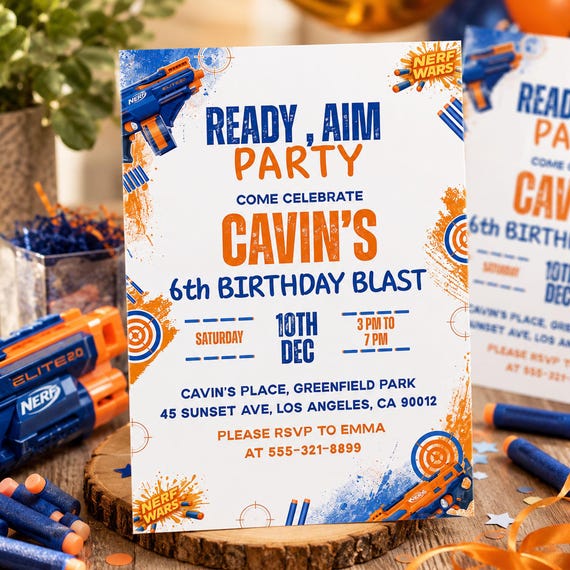
A themed invitation that sets expectations
Shop the find ↗A target set with different levels of difficulty
Targets give children something to aim at besides one another and make the activity accessible to guests with different confidence levels. Use a mixture of large, close targets and smaller or more distant ones so younger or less experienced players can enjoy early success before trying a harder challenge. You do not need a complicated scoring system. Award points for knocking down cups, hitting marked zones or completing a short sequence of targets, then reset everything between turns. Avoid placing targets near fragile objects, roads, stairs or areas where a missed dart could create a trip hazard.
A lightweight team bandana or colour marker
Simple team markers make a group battle easier to understand and reduce the time spent deciding who belongs where. Bandanas, fabric strips or coloured wristbands can divide players into two or more teams without relying on complicated names or printed equipment. Choose markers that are comfortable, easy to distinguish and not likely to catch on branches or furniture. Balance teams by age, confidence or experience rather than allowing the fastest children to choose all their friends. If the party includes children who do not want to compete, let them join as target setters, scorekeepers or photographers for a round before deciding whether to play.
A safe indoor or outdoor obstacle course
An obstacle course adds movement and strategy without requiring every child to own the same equipment. Use large, stable objects such as cardboard boxes, soft play pieces, garden furniture designed for outdoor use or clearly marked lanes. Leave wide walking routes and make sure children cannot hide behind unstable stacks or climb on improvised barriers. Keep the course simple enough to explain in under a minute. You might ask players to move between three safe cover points, collect a flag and return to base, or complete a target station before changing places. Walk the route yourself first, remove sharp or breakable items and pause the game immediately if running becomes too fast for the space.
A personalised birthday badge or patch
A small personalised badge, sticker sheet or fabric patch gives the birthday child a keepsake that does not depend on winning the main game. It can feature a callsign, team role or playful title such as “Mission Leader”, while guests receive simpler labels such as “Scout” or “Target Expert”. Use the personalisation to support inclusion rather than ranking children. Avoid labels that suggest one guest is the best shot or fastest player, since abilities and comfort levels can vary. If you are making stickers, place them on clothing rather than equipment and check whether any guest has sensitivities to adhesives before handing them out.
A mission-card game
Mission cards turn free play into a series of short challenges, which is helpful when attention spans differ or some guests need a break from firing darts. Write one clear instruction per card, such as “hit three targets”, “deliver the flag without being tagged” or “protect the base for two minutes”. Keep the tasks cooperative where possible so the group is not focused only on elimination. Prepare more cards than you expect to use and sort them by difficulty. Explain that a player may swap a card if it feels too difficult, too physical or simply not enjoyable. Short rounds are easier to reset than a single long competition, and they give late arrivals or children who need a pause a straightforward way to rejoin.
A comfortable storage case for equipment
A dedicated storage case is an unglamorous but genuinely useful gift because it prevents darts and accessories from spreading across the house. Choose a container with enough room for the equipment the child actually owns, with separate sections or pouches for darts, protective gear and small parts. Avoid overfilling the case or storing damaged darts with usable ones. A quick sorting routine after each play session can extend the life of the equipment and make the next game easier to start. If the case has a handle, check that it is suitable for the child’s age and that heavier equipment is carried by an adult when necessary.
A cooperative base-defence game
Not every child enjoys being eliminated, so a cooperative base-defence format is a strong alternative to traditional team battles. The group can protect a marked base, rescue a toy, or stop players from reaching a boundary while working toward a shared goal. Everyone gets a role, and the game ends when the group completes the mission rather than when one child is left standing. Give non-firing roles equal importance. A child might keep time, reset targets, carry the mission flag or call out a completed objective. Rotate roles every few minutes so quieter guests are not overlooked and confident players do not control every turn. This format also makes it easier to include different ages and comfort levels in the same activity.
A refill and repair kit
A practical refill kit can include compatible spare darts, a small container for collecting them and basic cleaning supplies approved for the equipment. Before buying anything, check the exact blaster or toy requirements rather than assuming all darts, magazines or accessories are interchangeable. Set a limit on how much ammunition is available at one time. Unlimited darts can make tidying difficult and encourage indiscriminate firing, while a controlled supply supports clearer rounds and easier supervision. Inspect equipment before the party, remove damaged pieces and keep small parts away from children who are too young to handle them safely.
A photo-friendly mission backdrop
A simple mission backdrop creates a place for the birthday child and guests to take a group photo without turning the whole party into a staged production. Use a plain wall, a fabric sheet or a few large, secure decorations, and add a sign with the party’s mission name if you want a personal touch. Keep the backdrop away from active play and avoid loose strings, sharp attachments or decorations that could fall when bumped. Take photos during a planned transition, such as after teams are assigned or before food is served, so guests are not interrupted mid-game. Ask parents about photo preferences where appropriate, particularly if images may be shared beyond the party.
A quiet reset activity
An action party benefits from a calmer option for children who need to recharge, arrive early or finish playing before everyone else. A colouring station, simple puzzle, sticker activity or mission-themed drawing challenge can be set up away from the main play area with seating, water and easy-to-follow instructions. The reset activity should not feel like a punishment or a place where children are sent for misbehaving. Present it as one of several available stations and let guests move between activities with reasonable guidance. This also gives the host a chance to serve food, check equipment and help children who need a quieter moment without stopping the whole party.
A useful take-home party favour
Choose a favour that supports continued play or creativity rather than adding a random plastic item to an already full party bag. A small target challenge sheet, personalised mission card, notebook for designing bases or set of age-appropriate craft materials can extend the theme without requiring every guest to receive identical equipment. If you include consumables or small items, check age suitability and any relevant warnings before packing them. Avoid giving darts or other pieces to guests without knowing whether they have compatible equipment at home. A short thank-you note or a card naming the guest’s team can make a modest favour feel intentional and connected to the party.